Optimize Your Content with Data, Not Guesswork
See how your terminology aligns with top-ranking pages and refine your content using measurable relevance data.
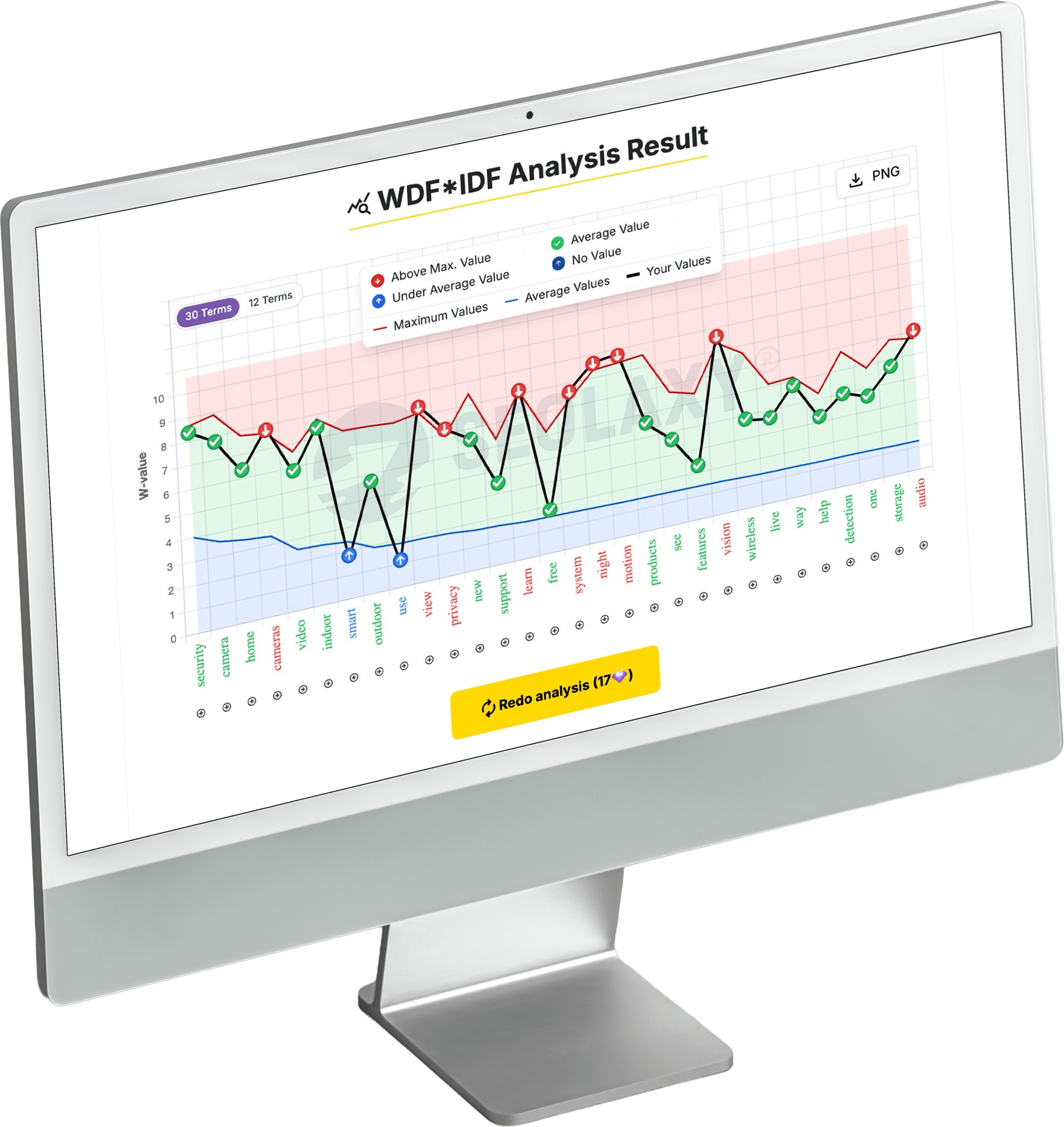
Use the SEOLAXY WDF*IDF tool to:
Identify relevant terms your competitors include but you might be missing
Spot overused or underused keywords compared to top-performing pages
Improve topical coverage and contextual depth
Refresh older content using measurable term comparisons
How SEOLAXY WDF*IDF Tool Works
The tool compares your content with top-ranking pages and calculates WDF*IDF values to show which terms are underused, balanced, or overused.
Enter your content – paste your text or add a page URL.
Set your keyword, country, and language.
Choose your stopword list – use the standard one, your own, or both.
i Gems are SEOLAXY tokens used to run analyses and unlock additional content available within the platform.
Frequently Asked Questions
What Is WDF*IDF?
WDF*IDF (Within Document Frequency * Inverse Document Frequency) is a mathematical formula used in SEO to analyze and optimize content by evaluating how terms are weighted within your document compared to other ranking pages on the web.
WDF*IDF emerged as a more sophisticated alternative to keyword density, which often led to over-optimized, barely readable content. This approach helps you create naturally flowing content while maintaining optimal term distribution.
How WDF*IDF works?
WDF*IDF measures how often specific terms appear in your content (Within Document Frequency) and compares that frequency with how often those terms appear in other pages covering the same topic (Inverse Document Frequency). SEOLAXY© WDF*IDF tool visualizes this comparison, showing which terms are underused, balanced, or overused.
What exactly does WDF*IDF measure?
It measures how often each term appears within your content (WDF) and how common it is across the top-ranking competitor pages (IDF). Together, they highlight which terms are statistically relevant for a given topic.
Why is WDF*IDF important for SEO?
It helps you understand how well your content reflects the terminology and topic coverage found in top-ranking pages. By using this insight, you can make your content more complete and relevant, without relying on keyword repetition.
Is WDF*IDF same as TF-IDF?
WDF*IDF is based on the TF-IDF formula used in information retrieval to measure how important a term is across a set of documents. It adapts that idea for SEO by adjusting how term frequency is calculated. WDF*IDF measures the relative weight of a term within one document (WDF) and compares it to how common it is across other pages (IDF). In short, it applies the TF-IDF concept specifically to content optimization.
How does WDF*IDF differ from keyword density?
Keyword density only measures how often a word appears in your own text. WDF*IDF compares your content with other top results, making it much more useful for identifying topical relevance rather than repetition.
Is WDF*IDF a ranking factor?
No. WDF*IDF is not part of Google's ranking algorithm. It's a diagnostic method that helps you understand term usage patterns among high-ranking pages.
When should I use the WDF*IDF tool?
WDF*IDF analysis is most useful when creating new, in-depth content, updating or refreshing existing pages, and checking how your text aligns with the terminology used in current top search results.
Can I analyze any page, not just mine?
Yes. You can analyze any URL or just a keyword to compare content performance against real search results.
How Can I Get Access to the SEOLAXY WDF*IDF Tool?
The WDF*IDF tool is available to SEOLAXY members. A SEOLAXY monthly membership includes gems that you can use not only for WDF*IDF analyses but also to unlock other content within the platform such as checklists, ticket templates, masterclass lessons, and workshops.
Trial users can run one analysis to see how the tool works before upgrading to a full membership.
How many gems does one WDF*IDF analysis cost?
One WDF*IDF analysis costs 27 gems. Running the same analysis again using the redo option costs 17 gems.
I have known Nedim for several years and would not want to miss the exchange with him. He is not only a luminary in the field of eCommerce SEO, but also knows how to convey this valuable knowledge properly.

Benjamin Rücker - Head of SEO @ Conrad.de
Nedim is the best SEO coach as far as I'm concerned. He imparts practical skills essential for real-world market situations, paired with business philosophy, in a very entertaining way. His expert knowledge has made a huge impact on my career.

Mladen Krstović - SEO Specialist @Oxygen Advantage
"After 23 Years Professional Experience In SEO My Mission Is To Be Always A Step Ahead"
When it comes to the recent changes in Google's algorithm, layout, and especially its AI Mode, I don't trust my gut feeling; I rely on my knowledge about the Google algorithm and my practical experience.
All my clients are already well positioned inside Google's AI Mode and prepared for the biggest change, where AI Mode will become Google's default.
You should leave everything else and concentrate on positioning your projects in Google's AI Mode ASAP! It's not a matter of years or months until this change becomes our new reality. We're talking about weeks or even just days.
Stop the guesswork and implement the points mentioned in this workshop exactly how I suggested you do. Most of your competitors are sleeping and missing out on this, but others are working in silence and waiting for their competitive advantage to kick in.
Soon we'll wake up and most websites will have ZERO traffic from Google's AI Mode because they didn't listen. Don't miss out on this, because there won't be a fast way to repair the damage, and you'll need to explain to your clients how you missed out on the most important change in Google's history.